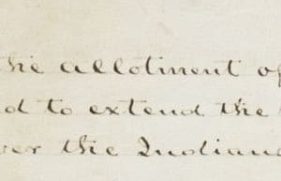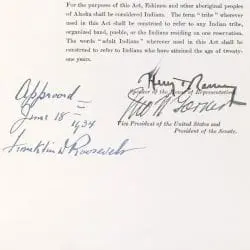
When the Wheeler-Howard Act, also known as the Indian Reorganization Act, passed on June 18, 1934, it brought an immediate end to the nearly 50-year federal-Indian policy of allotment, which enabled the government to open “excess” Indian land to non-Indian settlement and destroyed tribal communities.
Its stated purpose was: “To conserve and develop Indian lands and Resources; to extend to Indians the right to form business and other organizations; to establish a credit system for Indians; to grant certain rights of home rule to Indians; to provide for vocational education for Indians; and for other purposes.”
The Act replaced the allotment policy with a new policy which encouraged the revival of tribal governments and traditional Native American culture. The legislation gave tribes the choice to vote whether or not they wished to politically organize under the Wheeler-Howard Act.
Despite its good intentions, the Wheeler-Howard Act marked just a small step in the long path toward Native American self-determination—the practice of self-government and control over their own affairs. In the decades since, tribes have continued to encounter obstacles, but the Wheeler-Howard Act is credited with laying the foundation for the revival of many tribal governments and a return to greater tribal autonomy.
The Indian Reorganization Act is a part of America’s 100 Docs, an initiative of the National Archives Foundation in partnership with More Perfect that invites the American public to vote on 100 notable documents from the holdings of the National Archives. Visit 100docs.vote today.