In the early morning hours of August 6, 1945, a B-29 bomber named Enola Gay took off from Tinian island, where the US military had assembled the atomic bomb, and proceeded north by northwest toward Japan. The bomber’s primary target was the city of Hiroshima. It had a civilian population of almost 300,000 and was a critical military center that included 43,000 soldiers.
At approximately 8:15 a.m. Hiroshima time, the Enola Gay released “Little Boy”, the codename used for the first atomic bomb, over the city. Forty-three seconds later, a massive explosion lit the morning sky as the bomb detonated 1,900 feet above the city, directly over a parade field where soldiers of the Japanese Second Army were doing calisthenics.
The force of the explosion was later estimated at 15 kilotons (the equivalent of 15,000 tons of TNT). Some 70,000 people are estimated to have perished as a result of the initial blast, heat, and radiation effects. This included about 20 American airmen who were held as prisoners in the city. By the end of 1945, because of the continuing effects of radioactive fallout and other after effects, including radiation poisoning, the Hiroshima death toll was likely over 100,000. The five-year death total may have even exceeded 200,000, as cancer and other long-term effects are considered.
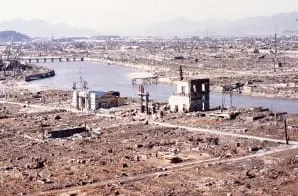
The above picture was taken in March 1946. The original caption reads: “General view of Hiroshima, Japan as seen from vicinity of ‘zero’, shows complete devastation as a result of atomic bombing.