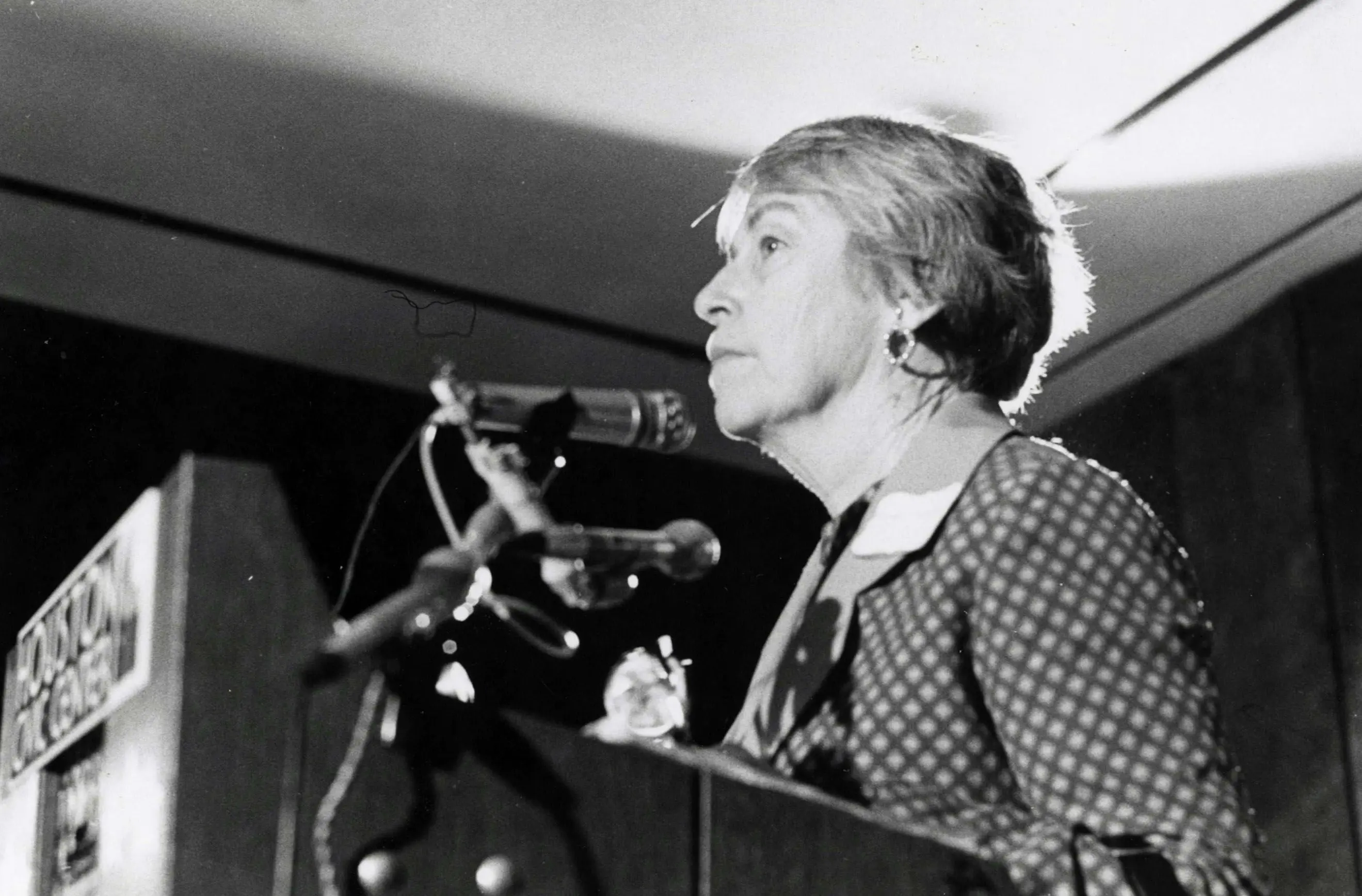
This photograph shows Martha Griffiths speaking at the Equal Rights Amendment Ratification Assembly, part of the 1977 National Women’s Conference in Houston, Texas. At the conference, 2,005 state delegates recommended to Congress and the President how to advance women’s rights.
The ERA was first drafted in 1923. From 1923 to 1970, some form of the ERA was introduced in every session of Congress. But, nearly every time that the ERA was introduced, it was held up in committee. In 1970, Griffiths filed a discharge petition to demand that the ERA be heard by the full House. A discharge petition, which requires the signatures of a majority of House members, forces proposed legislation out of committee so that it may be considered by the whole House of Representatives. Following the success of Griffiths’s discharge petition, the ERA was passed by the House. However, the Senate attempted to add provisions exempting women from the draft, which effectively killed the chances of the ERA passing that session.
After some changes to the wording of the amendment, Griffiths re-introduced the ERA in the 92nd Congress as HJ Res. 208. After months of debate, hearings and House Judiciary Committee proposed changes, the ERA, as introduced by Griffiths, was approved by the House on October 12, 1971. The Senate approved an identical version on March 22, 1972, sending the ERA to the states with a seven-year deadline for ratification. In 1978, with the deadline fast approaching, and the ERA lacking the required number of state ratifications, Congress extended the time limit to June 30, 1982 (viewed as a major achievement of the National Women’s Conference). However, by the time the extended deadline arrived, the ERA had only been ratified by 35 states – three states short of the three-fourths required for ratification of constitutional amendments.