During the Civil War, abolitionist and former slave Harriet Tubman Davis served as a scout in the Union Army, earning the distinction of being the first American woman to lead American troops into battle. She also served as a nurse, cook, and spy. After the war she received a pension as the widow of Union veteran Nelson Davis who had served as a private in the Eight United States Colored Infantry.
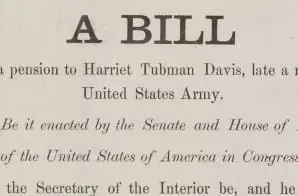
Tubman later petitioned Congress for additional benefits for her own service. Congress received numerous documents and letters supporting Tubman’s claim. On January 27, 1899, the House of Representatives passed the bill seen here, H.R. 4982, with an increase in Tubman’s pension from $8 to $25 a month.
H.R. 4982 was then sent to the Senate, which referred the matter to the Committee on Pensions. After consideration, the committee made its recommendation in Senate Report #1619. The Senate noted that very few nurses earned a pension of $20 per month. Ignoring her work as a cook and spy, the Senate stated that “there are no valid reasons why this claimant should receive a pension of $25 per month as a nurse, thus opening a new avenue for pension increases.” The report ended with the recommendation that the Senate amend the House bill to lower the pension amount to $20.