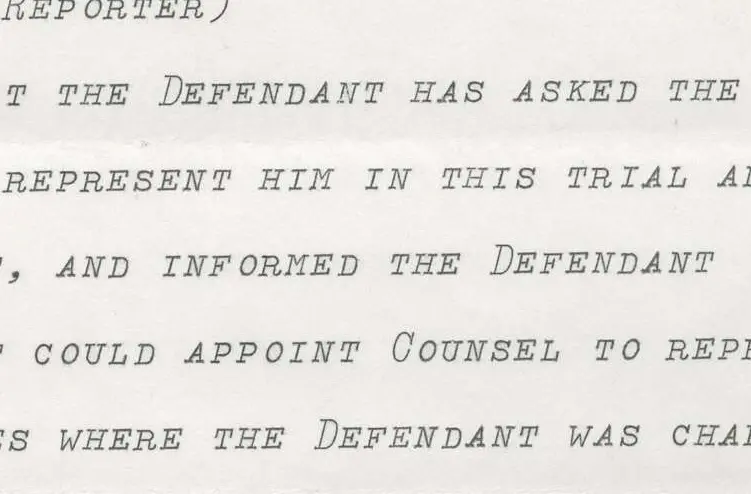
In 1961, Clarence Earl Gideon was charged with breaking and entering the Bay Harbor Pool Room in Florida with an intent to commit a misdemeanor. Gideon, a fifty-year-old man with an eighth-grade education and prior criminal history, could not afford a lawyer for the trial. He pleaded not guilty and requested a court-appointed lawyer. The judge refused because Florida only provided free lawyers in capital cases. This document, an excerpt from the court reporter’s transcript of that trial, shows Gideon’s request for counsel and the judge’s denial.
Gideon unsuccessfully defended himself and was convicted and sent to prison. He then submitted a petition to the U.S. Supreme Court, asking for his conviction to be overturned. The Court ruled that the 14th Amendment required the “assistance of counsel as a fundamental right essential to a fair trial” and sent Gideon’s case back to the Florida court.
This excerpt of the court reporter’s transcript from State of Florida v. Clarence Earl Gideon in the Circuit Court, Fourteenth Judicial Circuit of the State of Florida, in and for Bay County, is included in the appellate jurisdiction case file for Gideon v. Wainright (372 U.S. 335) in the Records of the Supreme Court.