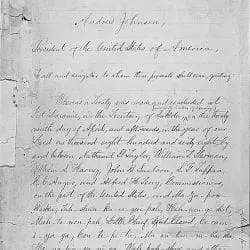
In this proclamation, President Andrew Johnson announces the ratification and confirmation of the Fort Laramie Treaty. He lists the principal negotiators of the agreement, including William T. Sherman, representing the United States.
In 1868, the Federal Government had established the Indian Peace Commission. Under the Commission, Sherman and his staff negotiated a peace treaty with the Sioux (Brule, Oglala, Miniconjou, Yanktonai, Hunkpapa, Blackfeet, Cuthead, Two Kettle, Sans Arcs, and Santee) and the Arapaho. All the tribes involved gave up many thousands of acres of land that had been promised in earlier treaties, but retained hunting and fishing rights in their older territory. They also agreed not to attack railroads or settlers. In exchange, the U.S. Government established a smaller reservation than before, consisting of a large portion of the western half of what is now the state of South Dakota, including the Black Hills.
After the Revolutionary War, the United States had continued the European practice of negotiating treaties with the Native Peoples similarly to how they negotiated with foreign governments. This practice changed gradually over time. In 1831, the Supreme Court case Cherokee Nation v. Georgia changed the status of Native tribes from “independent, sovereign nations” to “domestic dependent nations.” Treaties, however, still followed the pattern of requiring negotiations between the U.S. Government and tribal governments — ratification by Congress, the step seen in this document.