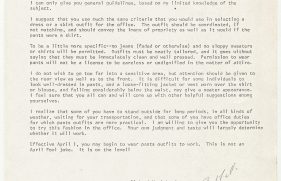
This letter from House Minority Leader Gerald Ford to President Richard Nixon lists Ford’s recommendations to fill the vice presidential vacancy. President Nixon later nominated Congressman Ford to be vice president.
In the late summer of 1973, Vice President Spiro T. Agnew had been under investigation by the U.S. Attorney’s office in Baltimore, Maryland, on charges of extortion, tax fraud, bribery, and conspiracy. In October, he was formally charged with having accepted bribes totaling more than $100,000 while holding office as Baltimore County Executive, governor of Maryland, and vice president of the United States. Agnew denied the bribery charge and pleaded no contest to a single charge that he had failed to report $29,500 of income received in 1967. On October 10, he was fined $10,000 and placed on three years’ probation. Earlier that day, he had resigned the vice presidency, becoming the first in U.S. history to do so because of criminal charges.
The Twenty-fifth Amendment, recently ratified in 1967, required President Richard M. Nixon to nominate a new vice president following Agnew’s resignation. This was the first time the amendment had come into play.
Nixon sought guidance on who to nominate from other government leaders, including House or Representatives Minority Leader Gerald R. Ford. Nixon asked Ford to request that members of the House of Representatives submit recommendations for the president’s consideration. Ford did so on October 11 at the House Republican Conference, explaining that the President had specified three criteria for the nominee. The person should be capable of serving as president, share the president’s views on foreign policy, and be able to work with members of both parties in Congress and be capable of confirmation by both houses.
The President received hundreds of suggestions, both from and outside Congress. Nixon took the suggestions with him to his retreat at Camp David, Maryland, the night of October 11. The next morning, he returned to the White House and announced to his staff that he had made a decision. At 9:06 p.m. on October 12, in the East Room of the White House – before cabinet officers, congressional leaders, members of the diplomatic corps, the Nixon family, and a live television audience – President Nixon announced that Gerald R. Ford was his vice presidential nominee. Ford had served in the House of Representatives from Michigan for 25 years, being reelected 12 times.
On Saturday, October 13, Ford’s name was officially submitted to Congress for confirmation. In considering Ford’s nomination, Congress was establishing precedent as it proceeded for, while the 25th Amendment requires confirmation by a majority vote in both houses, it does not specify a procedure for doing so. The Judiciary Committee in the House and the Rules Committee in the Senate handled the nomination.
The confirmation process took eight weeks. Because of the scandal surrounding Agnew’s resignation, and the growing speculation caused by the Watergate break-in that Ford might succeed to the presidency, members of both houses asked for a thorough background check of Ford. The Senate approved Ford’s nomination on November 27 by a vote of 92-3. The House approved the nomination on December 6 in a 387-35 vote.
One hour after the House vote, Ford was sworn in before a joint session of Congress, President Nixon, his cabinet, the entire Supreme Court, members of the diplomatic corps, friends, and family. It was the first time in U.S. history that a vice president was sworn in separately from a president.
Text adapted from “Letter from House Minority Leader Gerald R. Ford to President Richard M. Nixon” in the March 2001 National Council for the Social Studies (NCSS) publication Social Education.