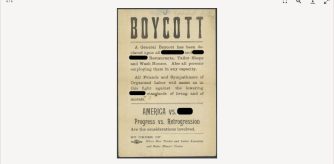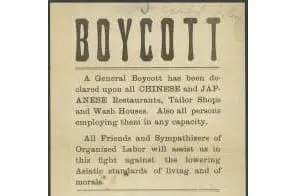
Like many places in the American West, Montana was the site of anti-Asian discrimination at the end of the 19th century. In late 1896, several labor unions in Butte boycotted both Chinese and Japanese owned businesses and businesses employing Asian workers, blaming these laborers and businesses for poor economic conditions.
Labor unions used flyers to notify their members and the public of this boycott. Many Chinese were forced to seek work in other cities. However, several merchants fought back and filed suit in Federal court in Butte requesting an injunction to stop the boycott as well as damages from the labor unions.
In the case Hum Lay, et al.. v. Baldwin, also known as the Chinese Boycott case, the court ruled in favor of the Chinese plaintiffs, a ruling that ran counter to the dominant public opinion of the time.