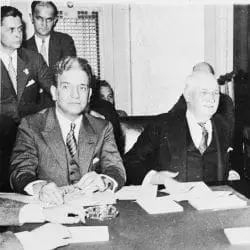
In January 1933, at the nadir of the Depression, the Senate Banking and Currency Committee renewed an earlier effort to find and fix the causes of the nation’s financial woes. The committee’s new chief counsel, Ferdinand Pecora, immediately set to work using his extensive subpoena power to dig deeply into the records of the top banks and financial firms in New York. He subpoenaed several Wall Street titans, including Charles E. Mitchell, chairman of the National City Bank, Albert H. Wiggins, former president of Chase National Bank, and J.P. Morgan, Jr., president of J.P. Morgan and Company. The hearings produced testimony that shocked the nation with tales of risky speculation, insider trading, preferential deals to public officials, tax evasion, fraud, and misconduct. The investigation provided detailed information about what was wrong, so that legislation could be produced to address the core problems. The Glass-Steagall Banking Act of 1933 created the Federal Deposit Insurance Corporation (FDIC) to insure bank deposits and required the separation of commercial and investment banking business so that commercial banks could not use customers’ savings deposits for risky speculation. The Securities Act of 1933 required a company offering its stock or bonds for sale to disclose certain information to allow buyers to make informed decisions about the purchase. The Securities Exchange Act of 1934 created the Securities and Exchange Commission (SEC) to oversee the stock market and prevent fraud.
Text adapted from “Letter to the Senate Banking Committee about Wall Street Reform Legislation during the New Deal” in the October 2009 National Council for the Social Studies (NCSS) publication Social Education.