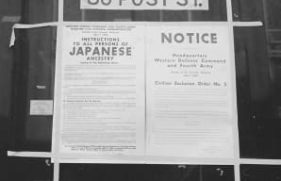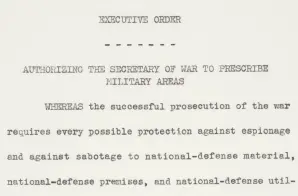
Issued by President Franklin Roosevelt on February 19, 1942, Executive Order 9066 authorized the Secretary of War to evacuate all persons deemed a threat to national security from the West Coast to “relocation centers” further inland.
Prior to the outbreak of World War II, the Federal Bureau of Investigation (FBI) had identified German, Italian, and Japanese aliens who were suspected of being potential enemy agents. Following the attack at Pearl Harbor, the West Coast was divided into military zones and suspect enemy aliens were kept under surveillance. By mid-January 1942, demands arose to exclude not only suspicious aliens whose origins were in belligerent nations, but all persons of Japanese descent, whether foreign born (issei) or American citizens (nisei). During congressional committee hearings, Department of Justice representatives raised constitutional and ethical objections to the proposal, so the U.S. Army carried out the task instead.
The West Coast was divided into military zones, and on February 19, 1942, President Franklin D. Roosevelt issued Executive Order 9066 that authorized military commanders to exclude civilians from military areas. Although the language of the order did not specify any ethnic group, Lieutenant General John L. DeWitt of the Western Defense Command proceeded to announce curfews that included only Japanese Americans. Next, he encouraged voluntary evacuation by Japanese Americans from a limited number of areas; about 7 percent of the total Japanese American population in these areas complied.
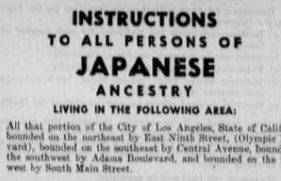
On March 29, 1942, under the authority of the President’s executive order, DeWitt issued Public Proclamation No. 4, which began the forced evacuation and detention of Japanese-American West Coast residents on a 48-hour notice. Only a few days prior to the proclamation, on March 21, Congress had passed Public Law 503, which made violation of Executive Order 9066 a misdemeanor punishable by up to one year in prison and a $5,000 fine.
From the end of March to August, approximately 122,000 men, women, and children were forcibly moved to “assembly centers.” They were then evacuated to and confined in isolated, fenced, and guarded “relocation centers,” also known as “internment camps.” The 10 sites were in remote areas in six western states and Arkansas: Heart Mountain in Wyoming, Tule Lake and Manzanar in California, Topaz in Utah, Poston and Gila River in Arizona, Granada in Colorado, Minidoka in Idaho, and Jerome and Rowher in Arkansas.
Nearly 70,000 of the evacuees were American citizens. There were no charges of disloyalty against any of these citizens, nor was there any vehicle by which they could appeal their loss of property and personal liberty. All lost personal liberties; most lost homes and property as well.
Although several Japanese Americans challenged the government’s actions in court cases, the Supreme Court upheld their legality. Nisei were nevertheless encouraged to serve in the armed forces, and some were also drafted. Altogether, more than 30,000 Japanese Americans served with distinction during World War II in segregated units.
For many years after the war, various individuals and groups sought compensation for those incarcerated. The speed of the “evacuation” forced many homeowners and businessmen to sell out quickly; total property loss is estimated at $1.3 billion, and net income loss at $2.7 billion (calculated in 1983 dollars based on a congressional commission investigation). The Japanese American Evacuation Claims Act of 1948, with amendments in 1951 and 1965, provided token payments for some property losses. More serious efforts to make amends took place in the early 1980s, when the congressionally established Commission on Wartime Relocation and Internment of Civilians held investigations and made recommendations. As a result, several bills were introduced in Congress from 1984 until 1988. In 1988, Public Law 100-383 acknowledged the injustice of the incarceration, apologized for it, and provided partial restitution – a $20,000 cash payment to each person who was incarcerated.
Executive Order 9066 is a part of America’s 100 Docs, an initiative of the National Archives Foundation in partnership with More Perfect that invites the American public to vote on 100 notable documents from the holdings of the National Archives. Visit 100docs.vote today.