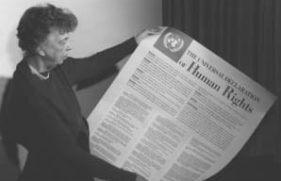
The Universal Declaration of Human Rights defines and enumerates principles first mentioned in the United Nations Charter. It promises equality and freedom for everyone everywhere.
With Eleanor Roosevelt as its driving force, the United Nations General Assembly adopted the Declaration with Resolution 217 A (III) on December 10, 1948, by a vote of 48-0 (8 abstaining).
Many people worked for this remarkable outcome, but observers believe that the UN Commission on Human Rights – whose work began during an especially bitter phase of the Cold War – would not have reached agreement without the leadership of the Commission’s chair: Eleanor Roosevelt.
Roosevelt herself regarded her role in drafting and securing adoption of the Universal Declaration of Human Rights as her greatest achievement. As she readily admitted, she had no legal training or expert knowledge of parliamentary procedure, but she brought to her job as chair the skills she had acquired as political activist, reformer, and advocate for those excluded from power and an understanding of the meaning of freedom earned through a deep engagement in the struggle in her own country for social and economic justice, civil rights, and women’s rights. She possessed not only a passionate commitment to human rights, but a hard-earned knowledge of the political and cultural obstacles to securing them in a divided world.
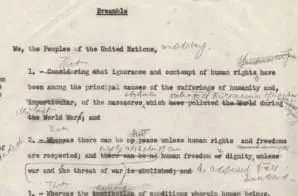
Eleanor Roosevelt’s draft preamble, with its numerous penciled suggestions and edits, reflects her deep involvement in the Declaration’s development; her efforts to engender and promote a lasting, international commitment to universal human rights; and her goal to secure enduring freedoms in a more peaceful world.
The Universal Declaration of Human Rights is a part of America’s 100 Docs, an initiative of the National Archives Foundation in partnership with More Perfect that invites the American public to vote on 100 notable documents from the holdings of the National Archives. Visit 100docs.vote today.