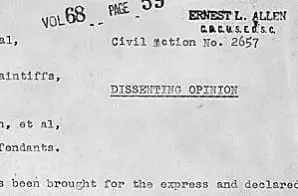
In 1950, twenty African-American parents from Clarendon County, South Carolina, sought better schools with educational facilities, curricula, equipment, and opportunities equal to those provided for white children, and challenged the constitutionality of “separate but equal” practices. This became the Briggs v. Elliot court case – one of the earliest challenges to public school segregation filed in Federal courts. Over the next five years, plaintiffs lost jobs, homes, and even lives. They were harassed and refused service and credit.
Harry Briggs, Jr., et al. v. R. W. Elliott, Chairman, et al. was heard in the Charleston District Court in May 1951 by a panel of three Federal judges. The majority ruling was that “separate but equal” schools were not in violation of the 14th amendment, with Judge J. Waites Waring dissenting.
This document is Judge Waties Waring’s dissenting opinion. In it, he presented some of the arguments that would later be used by the Supreme Court in Brown v. Board of Education of Topeka, Kansas.
The District Court did rule that the schools attended by African-American children were inferior to the white schools, and they ordered the school system to equalize the facilities. But, because Briggs v. Elliot challenged the constitutionality of segregation, the case was appealed to the U.S. Supreme Court. Briggs v. Elliot became one of the five cases that the Supreme Court heard collectively, consolidated under the name Brown v. Board of Education, that overturned the “separate but equal” doctrine.