• Sign In
  • Register
  • Sign In
  • Register
Sign in Sign up
  • <i class='bb-icon-file'></i><span class='link-text'>Primary Sources</span>
  • <i class='bb-icon-file'></i><span class='link-text'>Educational Activities</span>
  • <i class='bb-icon-file'></i><span class='link-text'>Popular Topics</span>
  • <i class='bb-icon-file'></i><span class='link-text'>Teaching Tools</span>
    • <i class='bb-icon-file'></i><span class='link-text'>Activity Tool Instructions</span>
    • <i class='bb-icon-file'></i><span class='link-text'>Guides and Resources</span>
  • Sign In
  • Register
Close search
naf-site-logo

A National Archives Foundation educational resource using primary sources from the National Archives

naf-logo-primary-blk
  • Primary Sources
  • Educational Activities
  • Popular Topics
  • Teaching Tools
    • Activity Tool and Instructions
    • Guides and Resources
  • Primary Sources
  • Educational Activities
  • Popular Topics
  • Teaching Tools
    • Activity Tool and Instructions
    • Guides and Resources
naf-site-logo
Back to All Documents
Download
Add to My Documents

If you are experiencing issues, try reducing the number of pages in the range above.


OR
Print

Petition from “Colored Women at Washington"

  • 1/15/1872
Share to Google Classroom

View the full document here: https://docsteach.org/document/dc-women-sumner-bill/

Description

After the ratification of the 14th and 15th Amendments, there was a great divide over how far the Government should go to enforce the rights established by these amendments. The 1875 Civil Rights Bill, first proposed by Senator Charles Sumner in 1870, was an attempt to codify those rights. Senator Sumner was the chief Radical Republican leader during Reconstruction and a vocal proponent of civil rights for freedmen.

Women in the District of Columbia sent this petition urging passage of the Sumner Civil Rights Bill. In eloquent and moving language, they describe the effect the deprivation of equal rights has had on them.

The bill that passed after much debate and revision in 1875 stated that all American citizens “shall be entitled to the full and equal enjoyment of the accommodations, advantages, facilities, and privileges of inns, public conveyances on land or water, theaters, and other places of public amusement.” Sumner, who died in 1874, did not live to celebrate the bill’s passage or to mourn its ultimate failure. In 1883, the U.S. Supreme Court ruled the Civil Rights Act of 1875 unconstitutional.
Transcript

[Four colored women at [illegible]]

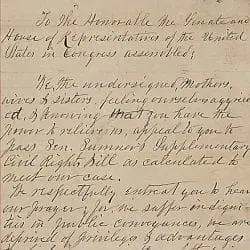
To the Honorable the Senate and House of Representatives of the United States in Congress assembled:

We, the undersigned, Mothers, wives & sisters, feeling ourselves aggrieved, & knowing that you have the power to relieve us, appeal to you to pass Sen. Sumner’s Supplementary Civil Rights Bill as calculated to meet our case.

We respectfully entreat you to hear our prayer: for we suffer indignities in public conveyances, we are deprived of privilege & advantages to which we are justly entitled in common with others. No principle was violated in the case of our Revolutionary Fathers that is not violated in our case.

Our grievances contain the essence of Slavery. The Slaveholder fed, clothed & housed his slave, poorly it is true & kept him in ignorance that the slave might not aspire to anything better than was contained in his lot. But we feed, clothe & shelter ourselves: we are striving for Education; making every effort to better our condition; & furthermore, we are taxed for the public benefit. We keenly feel all efforts made to keep us down & degrade us. [illegible strikethrough] We are told to aspire to all that is noble & elevating, to


than was contained in his lot. But we feed, clothe & shelter our-selves: we are striving for

Education; making every effort to better our condition; & furthermore, we are taxed for the public benefit. We keenly feel all efforts made to keep us down & degrade us. [struckthrough: not controlling the ballot] We are tied to aspire to all that is noble & elevating, to acquire all the conditions & surroundings of free citizens; and yet, we are subjected to mortifications, insults, & injuries, such as no free women can endure. Not controlling the ballot we are powerless to remedy the evils of which we complain; but though weak in this respect, we are morally strong in influencing our fathers, husbands & brothers; & we feel it a religious duty to use what strength we have in defence of outraged humanity; & in this spirit your petitioners will ever pray.

[left hand column]

Mrs. Louise C. Butler
Mrs. Jes T. Downing
Mrs. S.A.M. Washington
Mrs. Cordelia DeMortie
Mrs. Phillis Tallifano
Mrs. Ransom Parker
Anna Lang
Mrs. E. French
M. J. Williams
[illegible]
Mrs. James A. Harich
[illegible]
Mrs. Mary A. Hackett
Mrs. Elizabeth Johnson
Mrs. [illegible] Wilson
Mrs. [illegible] Jennings
Mrs. [illegible] Baston
Mrs. Annie M. Morrie
” C.A. Attwell
” M. M. [illegible]
Mrs. J. S. Marshall

[Right hand column]

Mrs. [illegible]
” Gufman
Mrs. A. L. Ketchum
M. [illegible]
Mrs. Mary [illegible]
Mrs. Corrie Thompson
Mrs. [illegible]
Mrs. Anna E. Blouden
Mrs. Anna E. Farrell
Rachel E. Bond
M. Betsey Johnson
Ms. Jane Thompson

Citation

This primary source comes from the Records of the U.S. Senate.

National Archives Identifier: 306406

Full Citation: Petition from women of the District of Columbia asking for the passage of the Sumner Civil Rights Bill; 1/15/1872; Petitions and Memorials Which Were Tabled Relating to Civil Rights and Political Disabilities; Anson McCook Collection of Presidential Signatures, 1789 – 1975; Records of the U.S. Senate, Record Group 46; National Archives Building, Washington, DC. [Online Version, https://docsteach.org/document/dc-women-sumner-bill/, April 2, 2026]

Rights: Public Domain, Free of Known Copyright Restrictions. Learn more on our privacy and legal page.

Related Documents

Browse All Documents
5-1-1899_W-013_46_Berryman

Not in Position to Give Up the Chase

The Development of the Industrial United States (1870-1900)
Not in Position to Give Up the Chase
3-28-1899_S-033_46_Berryman

Incorrigible

The Development of the Industrial United States (1870-1900)
Incorrigible
9-25-1899_W-051_46_Berryman

A Burden That Cannot Be Honorably Disposed of at Present

The Development of the Industrial United States (1870-1900)
A Burden That Cannot Be Honorably Disposed of at Present
207435326581-primary_14103_20250203095852

Complaint from Edwards Woodruff v. North Bloomfield Mining Company

The Development of the Industrial United States (1870-1900)
Complaint from Edwards Woodruff v. North Bloomfield Mining Company

Activities Featuring this Document​

Browse All Activities
No results found.

Explore Primary Sources

Explore Primary Source Documents

Discover Activities

Discover Activities You Can Teach With

Create Activities

Create Fun & Engaging Activities

  • Educational Programs
  • National Archives Museum
  • Presidential Libraries
  • Archives.gov
  • National Archives Foundation
  • Educational Programs
  • National Archives Museum
  • Presidential Libraries
  • Archives.gov
  • National Archives Foundation

About DocsTeach

DocsTeach is an interactive website hosted by and made possible with funding from the National Archives Foundation. It features activities from educators from around the country based on documents found in the National Archives holdings.

The Foundation is the National Archives’ nonprofit partner, supporting programs like DocsTeach to increase awareness of the National Archives and share America’s stories that spark curiosity, inspire discovery, and connect us to one another and our country.

X Facebook Youtube
  • FAQ
  • Contact Us
  • Privacy Policy
  • FAQ
  • Contact Us
  • Privacy Policy
by-no-sa

Except where otherwise noted, DocsTeach is licensed under a Creative Commons Attribution-NonCommercial-ShareAlike 4.0 International License. Primary source documents included on this site generally come from the holdings of the National Archives and are in the public domain, except as noted. Teaching activities on this site have received the CC0 Public Domain Dedication; authors have waived all copyright and related rights to the extent possible under the law. See our legal and privacy page for full terms and conditions.

  • Primary Sources
  • Educational Activities
  • Popular Topics
  • Teaching Tools
    • Activity Tool Instructions
    • Guides and Resources
  • Sign In
  • Register
  • Primary Sources
  • Educational Activities
  • Popular Topics
  • Teaching Tools
    • Activity Tool Instructions
    • Guides and Resources
  • Sign In
  • Register