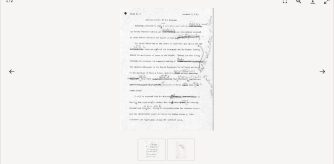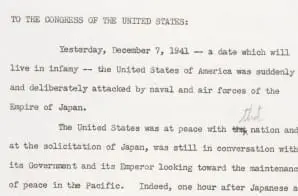
President Franklin D. Roosevelt delivered this joint address to Congress on December 8, 1941, the day after the Japanese attacked Pearl Harbor. This is the official copy of FDR’s speech presented to the Senate.
His famous “Day of Infamy” speech was a call to arms. He expressed outrage at Japan and confidence in the “inevitable triumph” of the United States. Roosevelt concluded by asking Congress to declare that a state of war existed between the United States and Japan. Immediately afterward, Congress declared war, and the United States entered World War II.
On December 7, 1941, the U.S. naval base on the island of Oahu, Hawaii, had been subject to an attack that was one of the greatest military surprises in the history of warfare. In less than two hours, the U.S. Pacific Fleet was devastated, and more than 3,500 Americans were killed or wounded. The Japanese attack on Pearl Harbor catapulted the United States into World War II.
The American people were outraged. Though diplomatic relations between the United States and Japan were deteriorating, they had not yet broken off at the time of the attack. Instantly, the incident united the American people in a massive mobilization for war and strengthened American resolve to guard against any future lapse of military alertness.
Early in the afternoon of December 7, 1941, President Franklin D. Roosevelt and his chief foreign policy aide, Harry Hopkins, were interrupted by a telephone call from Secretary of War Henry Stimson and told that the Japanese had attacked Pearl Harbor. At about 5 p.m., following meetings with his military advisers, the President calmly and decisively dictated to his secretary, Grace Tully, a request to Congress for a declaration of war. He had composed the speech in his head after deciding on a brief, uncomplicated appeal to the people of the United States rather than a thorough recitation of Japanese treachery, as Secretary of State Cordell Hull had urged.
President Roosevelt then revised the typed draft—marking it up, updating military information, and selecting alternative wordings that strengthened the tone of the speech. He made the most significant change in the critical first line, which originally read, “a date which will live in world history.” Grace Tully then prepared the final reading copy, which Roosevelt subsequently altered in three more places.
On December 8, at 12:30 p.m., Roosevelt addressed a joint session of Congress and the American people via radio. The Senate responded with a unanimous vote in support of war; only Montana pacifist Jeanette Rankin dissented in the House. At 4 p.m. that same afternoon, President Roosevelt signed the declaration of war.
President Franklin D. Roosevelt’s Day of Infamy Speech is a part of America’s 100 Docs, an initiative of the National Archives Foundation in partnership with More Perfect that invites the American public to vote on 100 notable documents from the holdings of the National Archives. Visit 100docs.vote today.