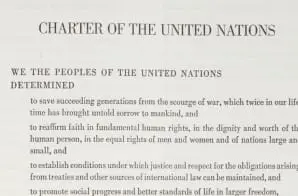
On June 26, 1945, in San Francisco, the United Nations was formally established with the signing of the UN Charter. Article 111 of this charter indicated that “The present Charter, of which the Chinese, French, Russian, English, and Spanish texts are equally authentic, shall remain deposited in the archives of the Government of the United States of America. Duly certified copies thereof shall be transmitted by that Government to the Governments of the other signatory states.”
The name United Nations originated with President Franklin Delano Roosevelt in 1941, when he described the countries fighting against the Axis Powers (Germany, Italy and Japan) in World War II. The name was first used officially on January 1, 1942, when 26 states joined in the Declaration by the United Nations, pledging to continue their joint war effort and not to make peace separately.
The United Nations was established after World War II in an attempt to maintain international peace and security and to achieve cooperation among nations on economic, social, and humanitarian problems. Its forerunner was the League of Nations, an organization conceived under similar circumstances following World War I. Established in 1919 under the Treaty of Versailles “to promote international cooperation and to achieve peace and security,” the League of Nations ceased its activities after it failed to prevent global war.
The need for an international organization to replace the League of Nations was first stated officially on October 30, 1943, in the Moscow Declaration issued by China, Great Britain, the United States, and the USSR. At the Dumbarton Oaks Conference in 1944, those four countries drafted specific proposals for a charter for the new organization. Later, at the Yalta Conference, in February of 1945, further agreement was reached on the framework and structure of the organization. Later that year, representatives of 50 nations attended the founding conference in San Francisco, where they drafted and later signed the UN charter. The required number of nations ratified the charter on October 24, 1945 (officially United Nations Day).
As outlined in the charter, the two main bodies of the United Nations are the General Assembly, composed of all member nations, and the Security Council. Today, nearly 200 nations are members of the United Nations General Assembly. The UN Security Council consists of the five victors from World War II (known as “The Big Five”) as permanent members—China, France, the United Kingdom, the USSR (now Russia), and the United States—and 10 other countries, elected by the General Assembly, that serve 2-year terms. The Security Council is the principal UN organ responsible for ensuring peace, and its decisions are binding on all member states. The five permanent members were given individual veto power over issues brought before the Council.
Other special agencies like WHO (World Health Organization), UNICEF (UN International Children’s Emergency Fund), UNESCO (UN Educational, Scientific, and Cultural Organization), and the World Bank provide needed help across the world and have improved the lives of millions.
The United Nations Charter is a part of America’s 100 Docs, an initiative of the National Archives Foundation in partnership with More Perfect that invites the American public to vote on 100 notable documents from the holdings of the National Archives. Visit 100docs.vote today.