At their first conference during World War II, from August 9-12, 1941, U.S. President Franklin D. Roosevelt and U.K. Prime Minister Winston Churchill held nine face-to-face meetings on board naval vessels anchored in Placentia Bay, off the coast of Newfoundland, Canada. The conference was devoted to an agreement on war aims and a vision for the future between at-war Great Britain and the technically neutral United States.
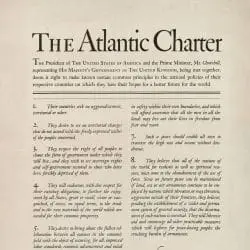
The document created at this meeting was the The Atlantic Charter. It set forth the concepts of self-determination, end to colonialism, freedom of the seas, and the improvement of living and working conditions for all people. Many of the ideas were similar to those proposed by President Woodrow Wilson’s Fourteen Points during World War I, which were not accepted by allies at the Versailles Conference.
One of the major provisions of the Atlantic Charter declared as follows:
[A]fter the final destruction of the Nazi tyranny, [we] hope to see established a peace which will afford to all nations the means of dwelling in safety within their own boundaries, and which will afford assurance that all men in all lands may live out their lives in freedom from fear and want. …[S]uch a peace should enable all men to traverse the high seas and oceans without hindrance.
The agreement is often cited as one of the first significant steps towards the formation of the United Nations.