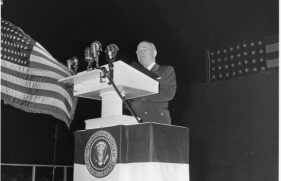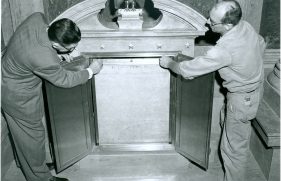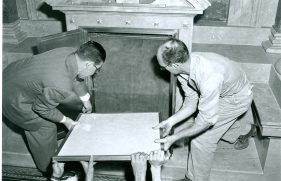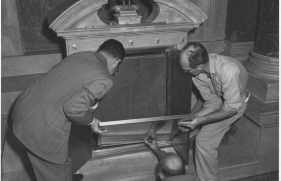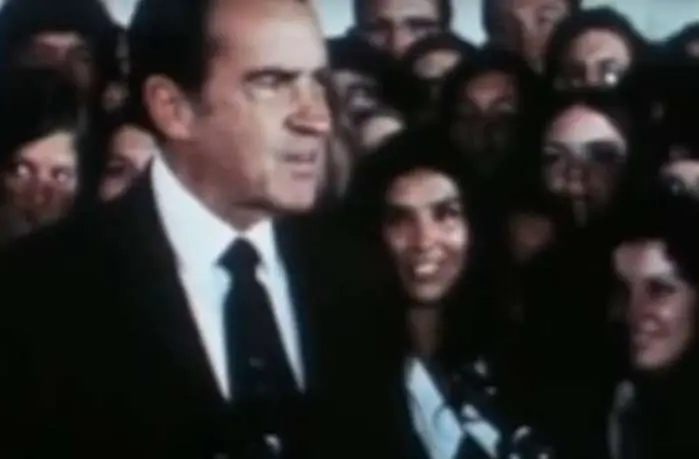
This is a video clip from the 26th Amendment certification ceremony on July 5, 1971 in the White House.
The 26th Amendment was ratified in 100 days, faster than any other amendment. In April 1970, Congress controversially lowered the voting age to 18 as part of legislation to extend the Voting Rights Act of 1965. Many people, including President Richard Nixon, believed that it was the right of the states, not the federal government, to set the voting age. President Nixon, nevertheless, signed the act, which was to go into effect January 1, 1971.
The effort to lower the voting age to 18 had begun three decades earlier. “Old enough to fight, old enough to vote,” a slogan first heard during World War II, was adopted by student activists during the Vietnam War.
In 1942, the slogan prompted Congressman Jennings Randolph of West Virginia to propose an amendment to the Constitution lowering the voting age to 18. Presidents Dwight D. Eisenhower and Lyndon B. Johnson both championed the cause. Activists during the Vietnam War increased pressure on Congress to change the voting age; and in 1971, when Senator Randolph reintroduced his original proposal, it passed overwhelmingly.
On December 21, 1970, the Supreme Court ruled that the government had indeed overstepped its legislative bounds in lowering the voting age. Fearing mass confusion over who could vote in the 1972 election, Congress quickly moved to pass the 26th Amendment. Ratification by the states was accomplished in a record four months.
The 26th Amendment to the Constitution was certified by General Services Administrator Robert Kunzig. In a ceremony at the White House, President Richard M. Nixon also signed as a witness. President Nixon’s signature was unnecessary to ratify the 26th Amendment because the Constitution does not give the President a role in passing amendments. But Nixon ceremoniously signed it anyway, and he took the unprecedented step of inviting three 18-year-olds to also sign the new amendment.