

Who Put You in Charge?

The Constitution outlines how Members of Congress, the President, and Supreme Court justices take office. American voters play a direct or indirect role in each process. Compare these three political cartoons by Clifford Berryman to distinguish who puts Members of Congress, the President, and Supreme Court Justices in charge.
Examine each cartoon carefully. Identify the people, objects, and places in each cartoon. Pay attention to the text.
After you have examined each cartoon, answer the discussion questions.
Complete the activity by answering the questions in the “When You’re Done” section.
Please Note: Activities may not be optimized on mobile devices. For the best experience, complete the activity on a desktop or laptop.
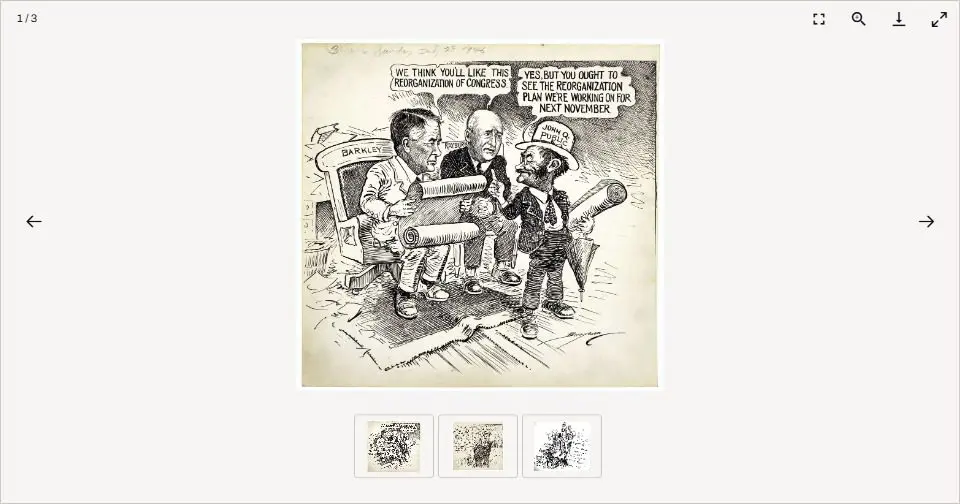
View the full activity: https://docsteach.org/activity/who-put-you-in-charge/
After you have examined each cartoon, answer the following questions:
- Are any of the visuals in the cartoon symbols? If so, what do you think they stand for?
- Which branch of government is represented in each cartoon?
Next, click on “View Primary Source Details” to learn more about the historical context behind what is happening in each cartoon.
Consider: How does the artist, Clifford Berryman, represent the process by which members of Congress, the President, and Supreme Court Justices take office? (Who decides who gets to be a Member of Congress, the President, and a Supreme Court Justice?) Use the corresponding sections of the Constitution for reference:
- Members of Congress: Article 1, Section 2 and the 17th Amendment
- The President of the United States: Article 2, Section 1 and the 12th Amendment
- The Supreme Court: Article 2, Section 2


