

How Do Political Cartoonists Convey their Points of View?

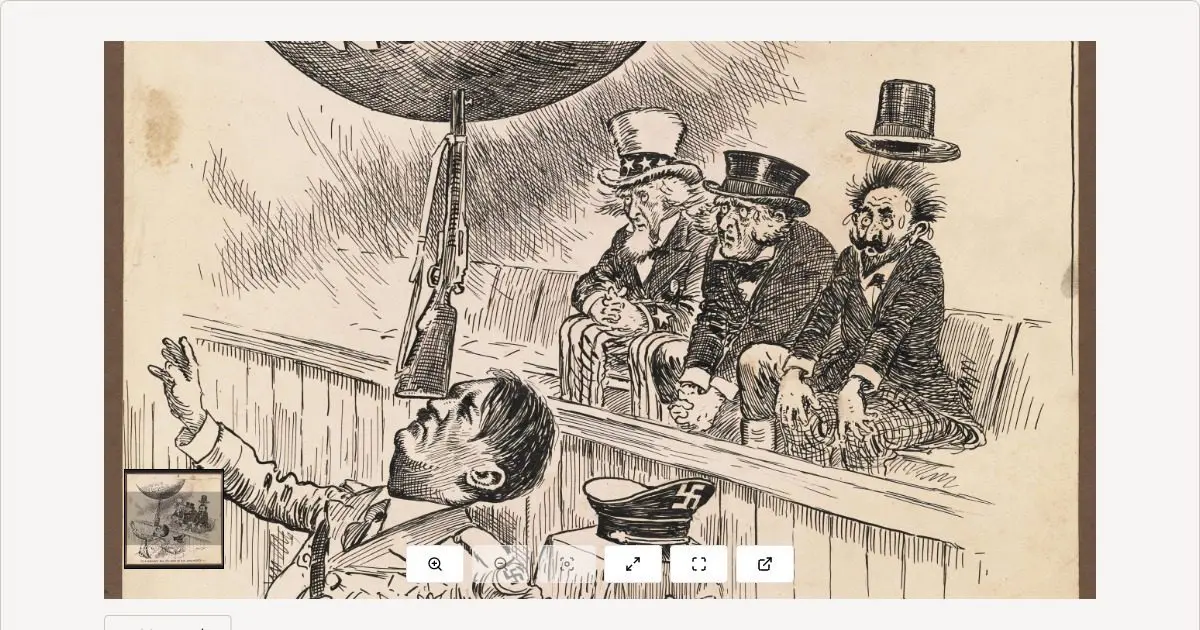
Quickly scan the cartoon. Think about what you notice first. Identify the caption and any words, people, objects, and places that Clifford Berryman, the artist who drew this cartoon, uses.
Next, decide which artistic techniques Berryman uses in the cartoon. Click on “+ Add Text” in the bottom left corner and label the techniques that you find. For each label, also include how the artist uses it. For example, if you identify a symbol, include what you think the symbol represents.
Here is a list of common political cartoon techniques for your reference:
- Personification: A human form used to represent an idea or thing.
- Symbol: A visual element that stands for something else. Symbols are often objects meant to represent ideas.
- Exaggeration: A characteristic that is overstated or heightened.
- Analogy: A comparison of two otherwise unlike things based on the resemblance of a particular aspect. Analogies are often used to explain complex ideas.
- Irony: Expressing the opposite of what is expected, or depicting a situation to be a certain way on the surface, when it is very different from how things really are.
To decode Berryman’s message and understand which techniques he employs in this cartoon, it may be helpful to see the newspaper where it originally appeared: the August 20, 1939 edition of the Washington Evening Star.
After you’ve finished labeling the cartoon, answer the questions in the “When You’re Done” section.
Please Note: Activities may not be optimized on mobile devices. For the best experience, complete the activity on a desktop or laptop.
View the full activity: https://docsteach.org/activity/how-do-political-cartoonists-convey-their-points-of-view/
