

Fingerprints and a Photo

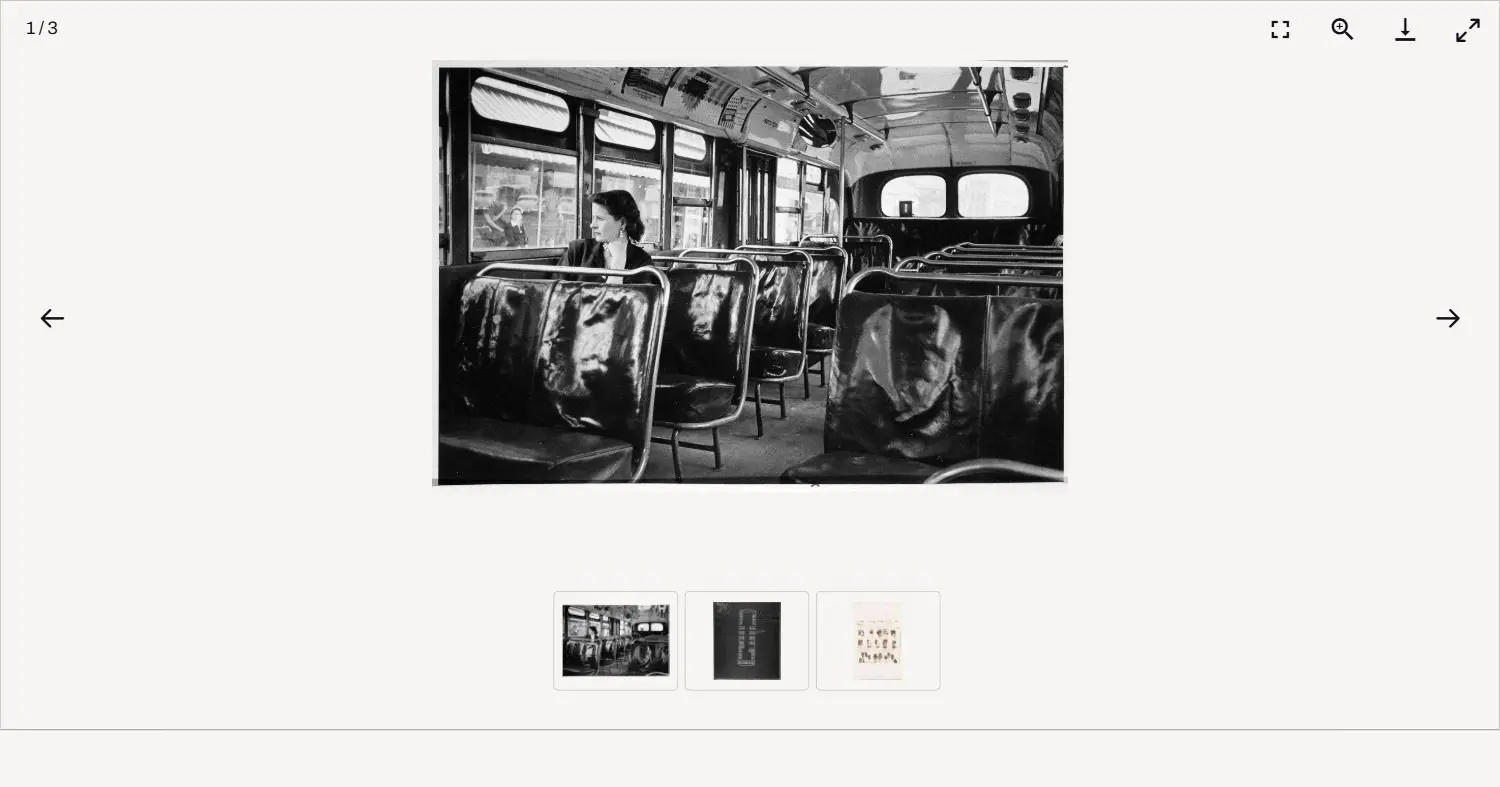
Document 1: This photograph of an almost empty bus was taken during the Montgomery Bus Boycott.
Document 2: This diagram shows where Rosa Parks was sitting when she refused to give up her seat to a white passenger. It was an exhibit in the Browder v. Gayle court case, which challenged Montgomery and Alabama laws requiring segregated seating on buses. On June 5, 1956, a Federal three-judge panel ruled that such laws violated the 14th Amendment. Later that year, the U.S. Supreme Court upheld the decision.
Text adapted from “The Arrest Records of Rosa Parks” in the May/June 1999 National Council for the Social Studies (NCSS) publication Social Education.
Document 3: This fingerprint card of Rosa Parks was produced in association with her arrest for refusing to obey orders of a bus driver on December 1, 1955, in Montgomery, Alabama.
It comes from the civil suit Browder vs. Gayle filed in U.S. District Court, challenging the constitutionality of the Montgomery and Alabama segregation laws. The plaintiffs in the case were Aurelia Browder, who was forced to give up her seat on a Montgomery city bus on April 29, 1955; Claudette Colvin, who had been arrested for refusing to give up her seat on a bus on March 2; and two other women, Mary Louise Smith and Susie McDonald. Their arrests, along with Rosa Parks’s in December, inspired Montgomery’s black community and the Women’s Political Council to plan the Montgomery Bus Boycott.
The U.S. District Court ruled in favor of the plaintiffs. The Supreme Court upheld the lower court’s decision, legally ending racial segregation on public transportation in the state of Alabama and ending the Montgomery Bus Boycott after 381 days.
Please Note: Activities may not be optimized on mobile devices. For the best experience, complete the activity on a desktop or laptop.
View the full activity: https://docsteach.org/activity/fingerprints-and-a-photo/
- How do the Rosa Parks fingerprints and her famous Montgomery Bus Boycott photo help tell the story of what she did, and why are they importance to the Civil Rights Movement?
- How did the Civil Rights Movement help make the promises in the Declaration of Independence and the Constitution more true for everyone?
