

Fannie Lou Hamer and Voting Rights

Fannie Lou Hamer was born in 1917 as the 20th child of parents who were sharecroppers. (Sharecroppers were tenant farmers who lived and worked on someone else’s land and gave a share of the crops to the landowner. It was almost impossible for the sharecroppers to earn enough to buy their own farm.) Hamer grew up picking cotton on a plantation, attended school only intermittently, and left school at age 12 to work full time. Fannie Lou married Perry Hamer (“Pap”) in 1944. The couple and their two adopted daughters were sharecroppers on a plantation in Ruleville, Mississippi.
In August 1962, Hamer attended a meeting of the Student Nonviolent Coordinating Committee (SNCC). Hamer said: “Until then I’d never heard of no mass meeting and I didn’t know that a Negro could register to vote” (Bond, Julian, Eyes on the Prize: America’s Civil Rights Years 1954-1965. 1987). At the meeting, Hamer volunteered to go to the courthouse in Indianola, Mississippi, the next day to register to vote – her right as a U.S. citizen.
Read the highlighted portion below, where Fannie Lou Hamer described her experience registering to vote in Mississippi in 1962. Then answer the questions that follow.
Please Note: Activities may not be optimized on mobile devices. For the best experience, complete the activity on a desktop or laptop.
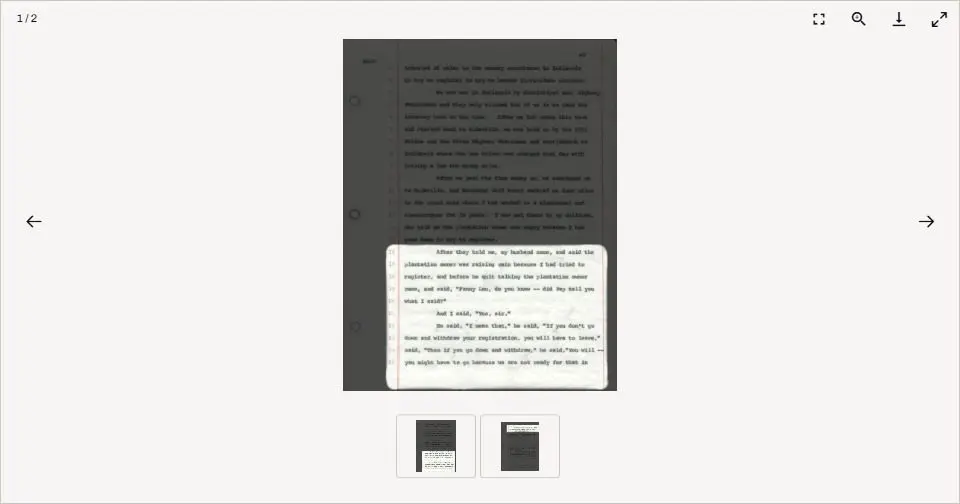
View the full activity: https://docsteach.org/activity/fannie-lou-hamer-and-voting-rights/
- Pap told Fannie Lou that the plantation owner was “raising cain.” What does that expression mean?
- Why was the plantation owner angry that Hamer registered to vote?
- How did he threaten her?
- What does the interaction between Hamer and the plantation owner tell you about what was happening in Mississippi and the South during the Civil Rights Movement?
- Read the first two paragraphs on the page. What happened to Fanny Lou Hamer and the group of people who tried to register to vote?
- Click on “View Primary Source Details” and look at page 3 of the document. What was Hamer’s response to the plantation owner after he threatened her? And what happened as a result?
