The Constitution at Work
Seeing the Big Picture
About this Activity
- Created by:National Archives Education Team
- Historical Era:Across Eras: Civics & Government
- Thinking Skill:Historical Analysis & Interpretation
- Bloom's Taxonomy:Analyzing
- Grade Level:High School
Please use a tablet or desktop computer to use this activity.
In this activity students will analyze documents that span the course of American history to determine their connection to the U.S. Constitution. Students will then make connections between the primary sources they have examined and sections of the Constitution, and determine the big idea(s) found in the Constitution exemplified by each.
For a version in Spanish, visit La Constitución en Acción.
https://docsteach.org/activities/student/the-constitution-at-workFor a version in Spanish, visit La Constitución en Acción.
Suggested Teaching Instructions
This activity should be taught following an introduction to the U.S. Constitution and discussion of each branch of government and its responsibilities. For grades 8-11. Approximate time needed is 50 minutes.You may wish to share a transcript of the U.S. Constitution and the history of its creation with students. Introduce vocabulary found in the text that might be unfamiliar to students, such as enumeration, ratification, amendment, jurisdiction or habeas corpus.
Choose one document in the grid to model careful document analysis and matching for students.
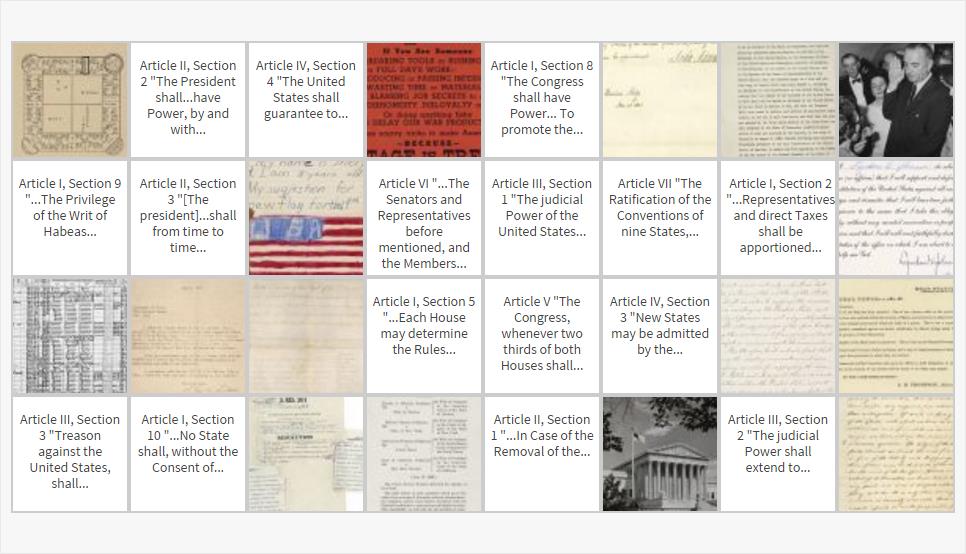
Divide the class into pairs or small groups. Ask students to begin the activity, analyzing each document for a possible link to the Constitution. Students should match each document with the specific article and section of the Constitution that it best demonstrates. (See the list of correct matches below.)
After concluding, brainstorm with students major themes or "big ideas" they found. Then display the following. Briefly discuss each idea and ask students to consider both the documents they have seen and the Constitution itself. Ask each student to conclude class with an example from a document or section of the Constitution that shows one of the following "big ideas":
- Representative Government - A system of government in which the people elect officials to govern for them. These officials are held accountable to the voters through periodic elections.
- Federalism - A form of government in which there is a constitutional division of power between a central government and regional governments.
- Checks and Balances - A system of overlapping powers of the separate branches of government that permits each branch to limit, restrain, or inform the actions of the other branches.
- Separation of Powers - A basic principle of American government that places different governing duties and powers among three independent and coequal branches: legislative, executive, and judicial.
- Enumerated Powers - The powers of government that are specifically defined and authorized in the actual wording of the Constitution.
- Implied Powers - The powers of government that, while not specifically defined and authorized in the Constitution, are not specifically prohibited.
- Civic Responsibility - Actions by the people that demonstrate their interest and participation in the governing of their country.
The correct matches for the activity are:
Population Schedule for the 1930 Census Listing Mikael Amerikian - Article I, Section 2 "...Representatives and direct Taxes shall be apportioned among the several States which may be included within this Union, according to their respective Numbers, which shall be determined by adding to the whole Number of free Persons, including those bound to Service for a Term of Years, and excluding Indians not taxed, three fifths of all other Persons. The actual Enumeration shall be made within three Years after the first Meeting of the Congress of the United States, and within every subsequent Term of ten Years, in such Manner as they shall by Law direct. The Number of Representatives shall not exceed one for every thirty Thousand, but each State shall have at Least one Representative; and until such enumeration shall be made, the State of New Hampshire shall be entitled to chuse three, Massachusetts eight, Rhode-Island and Providence Plantations one, Connecticut five, New-York six, New Jersey four, Pennsylvania eight, Delaware one, Maryland six, Virginia ten, North Carolina five, South Carolina five, and Georgia three."
Resolution to Censure Senator Joseph McCarthy - Article I, Section 5 "...Each House may determine the Rules of its Proceedings, punish its Members for disorderly Behaviour, and, with the Concurrence of two thirds, expel a Member."
Drawing for a Game Board - Article I, Section 8 "The Congress shall have Power... To promote the Progress of Science and useful Arts, by securing for limited Times to Authors and Inventors the exclusive Right to their respective Writings and Discoveries"
President Lincoln's Proclamation Suspending the Writ of Habeas Corpus - Article I, Section 9 "...The Privilege of the Writ of Habeas Corpus shall not be suspended, unless when in Cases of Rebellion or Invasion the public Safety may require it."
State of Maine General Order Number 57 - Article I, Section 10 "...No State shall, without the Consent of Congress, lay any Duty of Tonnage, keep Troops, or Ships of War in time of Peace, enter into any Agreement or Compact with another State, or with a foreign Power, or engage in War, unless actually invaded, or in such imminent Danger as will not admit of delay."
Photograph of Lyndon Baines Johnson Taking the Presidential Oath of Office - Article II, Section 1 "...In Case of the Removal of the President from Office, or of his Death, Resignation, or Inability to discharge the Powers and Duties of the said Office, the Same shall devolve on the Vice President, and the Congress may by Law provide for the Case of Removal, Death, Resignation or Inability, both of the President and Vice President, declaring what Officer shall then act as President, and such Officer shall act accordingly, until the Disability be removed, or a President shall be elected."
Nomination of John Marshall to the Supreme Court - Article II, Section 2 "The President shall...have Power, by and with the Advice and Consent of the Senate, to make Treaties, provided two thirds of the Senators present concur; and he shall nominate, and by and with the Advice and Consent of the Senate, shall appoint Ambassadors, other public Ministers and Consuls, Judges of the supreme Court, and all other Officers of the United States, whose Appointments are not herein otherwise provided for, and which shall be established by Law: but the Congress may by Law vest the Appointment of such inferior Officers, as they think proper, in the President alone, in the Courts of Law, or in the Heads of Departments."
The Monroe Doctrine - Article II, Section 3 "[The president]...shall from time to time give to the Congress Information of the State of the Union, and recommend to their Consideration such Measures as he shall judge necessary and expedient; he may, on extraordinary Occasions, convene both Houses, or either of them, and in Case of Disagreement between them, with Respect to the Time of Adjournment, he may adjourn them to such Time as he shall think proper; he shall receive Ambassadors and other public Ministers; he shall take Care that the Laws be faithfully executed, and shall Commission all the Officers of the United States."
Photograph of Supreme Court Building - Article III, Section 1 "The judicial Power of the United States shall be vested in one supreme Court, and in such inferior Courts as the Congress may from time to time ordain and establish. The Judges, both of the supreme and inferior Courts, shall hold their Offices during good Behaviour, and shall, at stated Times, receive for their Services a Compensation, which shall not be diminished during their Continuance in Office...."
Opinion of the Court by Chief Justice Earl Warren in the Case of Miranda v. Arizona - Article III, Section 2 "The judicial Power shall extend to all Cases, in Law and Equity, arising under this Constitution, the Laws of the United States, and Treaties made, or which shall be made, under their Authority;--to all Cases affecting Ambassadors, other public Ministers and Consuls;--to all Cases of admiralty and maritime Jurisdiction;--to Controversies to which the United States shall be a Party;--to Controversies between two or more States;-- between a State and Citizens of another State,--between Citizens of different States,--between Citizens of the same State claiming Lands under Grants of different States, and between a State, or the Citizens thereof, and foreign States, Citizens or Subjects...."
What is sabotage? Sabotage is treason! Poster - Article III, Section 3 "Treason against the United States, shall consist only in levying War against them, or in adhering to their Enemies, giving them Aid and Comfort. No Person shall be convicted of Treason unless on the Testimony of two Witnesses to the same overt Act, or on Confession in open Court...."
Letter from Sheryl Byland to President Eisenhower - Article IV, Section 3 "New States may be admitted by the Congress into this Union; but no new State shall be formed or erected within the Jurisdiction of any other State; nor any State be formed by the Junction of two or more States, or Parts of States, without the Consent of the Legislatures of the States concerned as well as of the Congress...."
Letter from LeRoy M. Satrom about Kent State - Article IV, Section 4 "The United States shall guarantee to every State in this Union a Republican Form of Government, and shall protect each of them against Invasion; and on Application of the Legislature, or of the Executive (when the Legislature cannot be convened), against domestic Violence."
Tennessee's Ratification of the 19th Amendment - Article V "The Congress, whenever two thirds of both Houses shall deem it necessary, shall propose Amendments to this Constitution, or, on the Application of the Legislatures of two thirds of the several States, shall call a Convention for proposing Amendments, which, in either Case, shall be valid to all Intents and Purposes, as Part of this Constitution, when ratified by the Legislatures of three fourths of the several States, or by Conventions in three fourths thereof, as the one or the other Mode of Ratification may be proposed by the Congress; Provided that no Amendment which may be made prior to the Year One thousand eight hundred and eight shall in any Manner affect the first and fourth Clauses in the Ninth Section of the first Article; and that no State, without its Consent, shall be deprived of its equal Suffrage in the Senate."
Senator Lyndon B. Johnson's Oath of Office - Article VI "...The Senators and Representatives before mentioned, and the Members of the several State Legislatures, and all executive and judicial Officers, both of the United States and of the several States, shall be bound by Oath or Affirmation, to support this Constitution; but no religious Test shall ever be required as a Qualification to any Office or public Trust under the United States."
Delaware's Ratification of the U.S. Constitution - Article VII "The Ratification of the Conventions of nine States, shall be sufficient for the Establishment of this Constitution between the States so ratifying the Same...."
Documents in this activity
- Constitution of the United States
- Delaware's Ratification of the U.S. Constitution
- Drawing for a Game Board
- Letter from LeRoy M. Satrom
- Letter from Sheryl Byland to President Eisenhower
- Lyndon Baines Johnson Taking the Presidential Oath of Office
- The Monroe Doctrine
- Nomination of John Marshall to the Supreme Court
- Opinion of the Court by Chief Justice Earl Warren in the Case of Miranda v. Arizona
- Population Schedule for the 1930 Census Listing Mikael Amerikian
- President Lincoln's Proclamation Suspending the Writ of Habeas Corpus
- Resolution to Censure Senator Joseph McCarthy
- Senator Lyndon B. Johnson's Oath of Office
- State of Maine General Order Number 57
- Supreme Court Building
- Tennessee's Ratification of the 19th Amendment
- What is sabotage? Sabotage is treason!

To the extent possible under law, National Archives Education Team has waived all copyright and related or neighboring rights to "The Constitution at Work".